

Aspartame Is a "Possible Carcinogen." So Are Pickled Vegetables.
What that alarming label actually means, and what half a century of studies did and didn't find.

Part 1 of 3 on artificial sweeteners: a scientist reads the cancer scares and 50 years of toxicology, and what kept coming back null.
Morgan McSweeney, PhD (@dr.noc)
Every few months a new headline turns a sweetener into a suspect: aspartame is a “possible carcinogen”; this product is “linked to strokes”; the stuff in your coffee is “wrecking your gut.” Each one lands as a little jolt of dread and leaves you standing in the kitchen holding a can of Diet Coke wondering whether it is a live grenade.
I went and read the actual studies, the alarming ones and the reassuring ones, in animals and in people. My blunt read: the non-sugar sweeteners are some of the most heavily tested additives in the entire food supply, and the scariest claims about them (cancer, seizures, birth defects) keep coming back null in the studies built to catch them.
However, the opposite type of headline, the “it’s totally inert” line of messaging, also feels like an oversimplification that I have never felt particularly comforted by. So, I decided to look more closely.
I write these letters early. Lately, my research and writing routine is a very early morning session, starting around 4am, when everyone else in the house (including Franklin, our dog) is still asleep. But sometime around 5 or 5:30am, I usually hear Franklin let out a big yawn halfway across the living room. When I look over from my desk at the side of the room, I can see him doing his big stretch, and then he sleepily walks his way over to stand at my side with his tail slowly wagging as a greeting. That is his way of politely asking if he can go outside to go to the bathroom, which is my cue to give him a scratch on the chest, turn off the house alarm, and let him into our backyard. And, 99% of the time, I remember every step in that sequence: 1) scratch him on the chest, 2) turn off the alarm, 3) open the door to let him go pee.
Alas, on those fateful remaining 1% of mornings, I forget step #2.
This morning was one such morning. Everyone else, sleeping peacefully in the household, woke up to the ambience of the blaring alarm ripping through the house like a banshee who stubbed her toe. To add to the immediate chaos, right as the alarm started its pre-dawn shriek, Franklin happened to see the family of nine deer that live in the forest near our community, and he started barking like a terrified (but loyal) guard hound. So I had to run inside and make sure the alarm was turned off and then run back outside to assure our 55-pound retriever that the deer were no threat (despite their hoof-stomping). Zina sent me a worried “are you ok?” text, and I quickly responded “forgot the alarm while taking dog out.”
Now, here I am back at my desk, decidedly awake. Everyone has settled back to sleep after the disruption. Franklin is back inside, laying on the carpet next to me (not asleep, but also not anxious), and I am clicking through my browser tabs trying to remember where I left my train of thought.

A scary health headline does the same thing to your body that my house alarm did: a sudden blast of adrenaline that feels like danger. But, an alarm going off or a dog barking in the backyard only tells you that something moved. The only way to know whether it is a real intruder or just the same family of nine deer stomping their hooves in the tree line is to walk outside and look. That is the goal today: to take a look at the data on artificial sweeteners.
My takeaway is that, although I don’t personally drink soda in general, if I did drink sugar-sweetened sodas, I would be comfortable replacing them with artificially sweetened sodas.
What artificial sweeteners even are
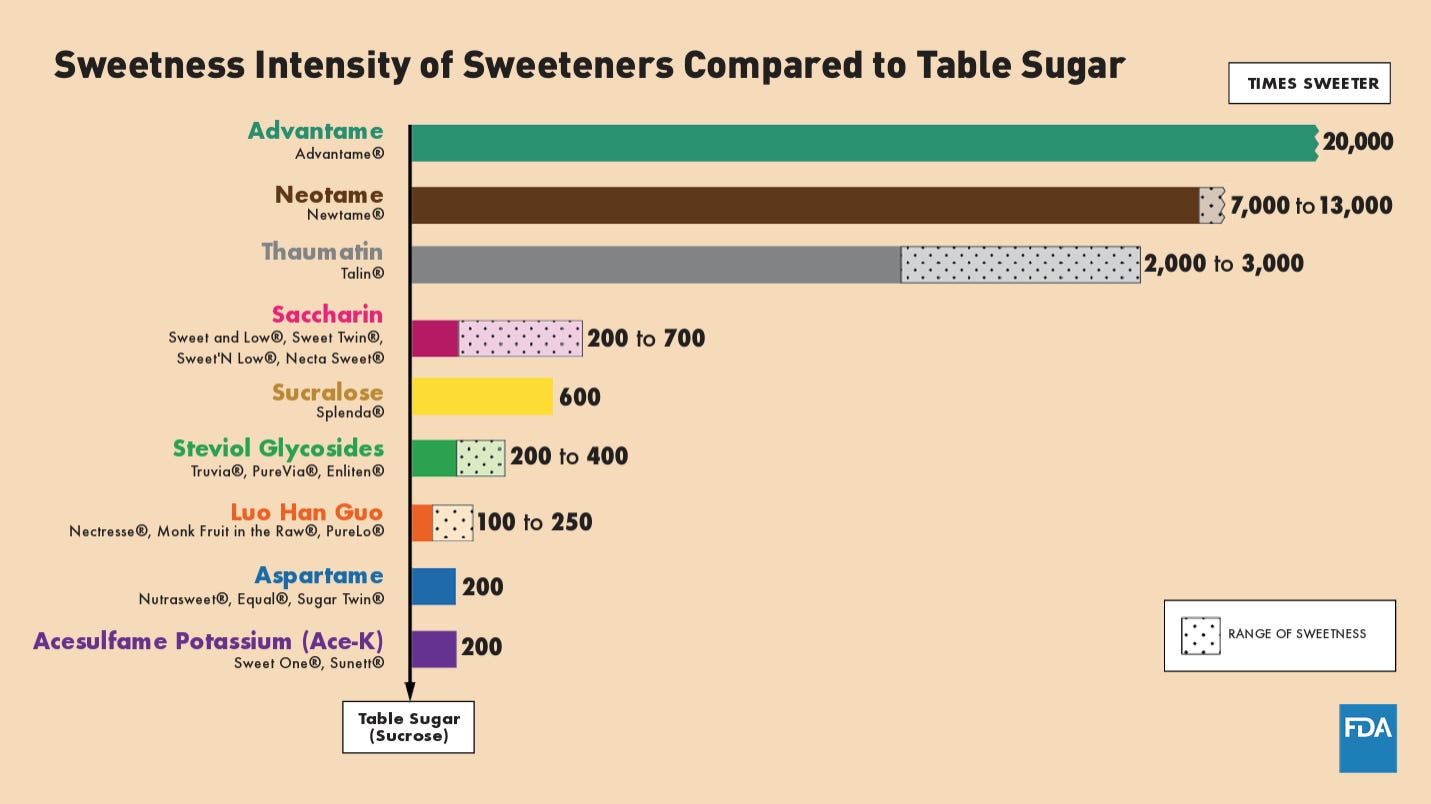
There are six intensely sweet compounds the FDA has cleared as food additives: saccharin, aspartame, acesulfame-potassium, sucralose, neotame, and advantame. They are called “high-intensity” for a reason. Saccharin is a few hundred times sweeter than table sugar, sucralose about 600 times, and advantame is roughly 20,000 times sweeter, which is why the amount in your drink is measured in milligrams.
Most of them are not really “food” in the sense your body cares about. Saccharin and acesulfame-K pass through you and leave in your urine chemically unchanged. The majority of sucralose is never absorbed at all and exits in your stool. The one exception is aspartame, which your gut takes apart completely into two amino acids and a small amount of methanol. Importantly, all three of these metabolic products show up in ordinary foods and beverages (like fruit or milk), often in larger quantities than a diet soda delivers. As a note, that metabolic breakdown is also why aspartame carries a warning for people with phenylketonuria, a rare genetic condition in which one of those amino acids, phenylalanine, builds up dangerously.
Then, there are the “natural” sweeteners, stevia and monk fruit, that are marketed as the wholesome alternative. Upon my reading, the “natural versus artificial” line is a distinction without a difference: it is a marketing and sometimes a regulatory distinction, but it does not imply a different category of health risk. The stevia in your pantry is of course not a leaf; it is a purified isolate of specific molecules (steviol glycosides) because, ironically enough, the FDA has considered some of the less-purified, crude stevia extracts to have “inadequate toxicological information” (per Import Alert 45-06).
The WHO puts purified stevia in the same category as aspartame and sucralose and calls the whole group “non-sugar sweeteners.”
I prefer that approach rather than having two confusing groups of “artificial” and “natural” non-sugar sweeteners. The differences that actually separate these compounds are things like whether your body absorbs them and what your gut bacteria do with them, not whether a plant or a chemist made them first.
Sugar Alcohols (erythritol, xylitol, “-ol”)
One category gets swept into these arguments but does not belong there: the sugar alcohols, like erythritol and xylitol. Those are a different kind of molecule, are partly absorbed, partly caloric, are often responsible for the gastrointestinal complaints people sometimes blame on “sweeteners” in general. Those are different from the class of sweeteners you might find in Diet Coke.
They receive a lot of headlines, though, so let’s quickly cover some basics.
If you have heart disease or a history of blood clots, you may have heard some concerning news in the past couple of years. A few studies from one research group have tied higher blood levels of erythritol and xylitol to stickier platelets and to increased risk of heart attacks and strokes. I take that seriously, but the evidence is a lot shakier than the headlines suggest, for several reasons: it comes primarily from a single research group, it is observational data with potential confounding issues, and it turned up in high-risk patients already sick enough to be in a cardiac workup. The FDA reviewed the main erythritol study, discussed its merits and limitations in depth, and has not changed how it is regulated.
So, it is a real research signal, but it is one that nobody has yet shown to be a real-world harm, and that has not been replicated outside of the studies from that one research group. The data are simply not strong enough to warrant broad discouragement of sugar alcohols. And yet, the downside of easing off sugar alcohols is low, assuming you’re not replacing them with a bunch of added sugars. So, I can easily see how a reasonable person with a relevant medical history could decide to drop products with sugar alcohols.
(I will take more time with the sugar alcohols in a separate letter.)
What “possibly carcinogenic” actually means
In July 2023, the International Agency for Research on Cancer classified aspartame as Group 2B, “possibly carcinogenic to humans.” The phrase traveled far and wide over social media through misleading headlines like this.
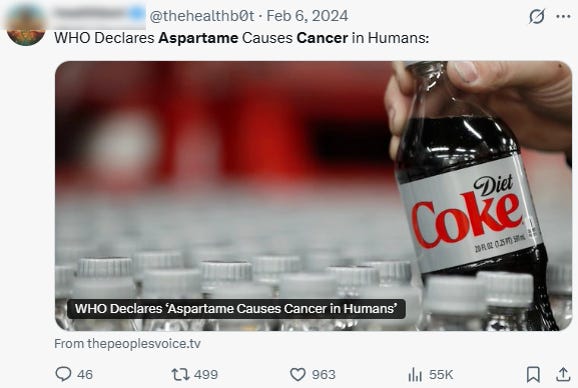
IARC’s classifications describe how strong the evidence is that something can, under some circumstances, cause cancer. They deliberately say nothing about how much risk a substance poses at the doses people actually encounter.
Group 2B, in a case like aspartame’s, is the tier used when the human evidence is “limited,” meaning there is some suggestive evidence but it also could potentially be explained by chance or research method bias (the latter being more relevant in the observational studies for aspartame). It is a category that is shared by hundreds of agents including aloe vera extract and, believe it or not, pickled vegetables. Being in a category with pickles is not a reason to panic. On the same day IARC assigned that label, WHO’s food-safety committee reviewed the same evidence and reaffirmed the existing safe intake, stating there was “no convincing evidence” of harm from aspartame at the normal levels of consumption.
Two arms of the same organization, reading the same studies, and the shared interpretation between their findings is that the hazard may theoretically be on the table for the molecule, but the real-world risk at real-world intake levels has not been demonstrated.
Who has some reason to be extra cautious?
For most healthy adults, swapping sugar for a sweetener in moderation is a very defensible trade, as we will discuss in detail further below. But a few groups have reasons to consider limiting or avoiding.
If you have PKU (phenylketonuria): don’t eat/drink aspartame. This is a hard rule. Aspartame breaks down into phenylalanine, which you cannot clear, which is exactly what that warning label on the can is for.
If you are pregnant: the signal on artificial sweeteners is soft and not particularly worrisome, and the data probably say more about heavy soda drinking in general than about any specific sweetener, since several of the same studies often flag risk associations with sugary soda, too. However, this is another reasonable circumstance to ease off soda (of any kind) and switch to trying out some unsweetened beverages. But the specific choice of a replacement is important. I would support switching from diet soda to something like sparkling water with a slice of cucumber and lemon all day long. However, for example, the data do not support switching from diet sodas to sugary sodas in pregnancy.
For most people, these remain approved as safe within normal consumption levels, and in moderation they are a reasonable step down when used as a replacement for added sugars.
In the rest of today’s deep dive:
How much do you have to eat/drink for it to be considered “a lot?” per regulatory standards
The toxicology: the animal studies, the DNA-damage tests, and the largest human study ever run on this (roughly 474,000 people).
One lab keeps finding cancer in animal models, and why regulators on both sides of the Atlantic set its work aside.
The original sweetener cancer scare, saccharin and the rats, and the biological reason the argument fell apart so conclusively that the government removed the warning label from cans.
“Doesn’t aspartame turn into formaldehyde?” A tiny sliver of truth that is greatly misrepresented. The embalming-fluid claim vs. a glass of fruit juice.
Heart, blood sugar, seizure, headache, allergy, and pregnancy questions, and the available data.
(Opinion) My bottom line: what I do about all of this.
A paid subscription also opens the full archive. A few reader favorites: i) The Heart Attack That “Came Out of Nowhere”, ii) The Truth: Is Alzheimer’s Preventable?, and iii) Creatine: What Works and What’s Hype.
This letter is not sponsored, there are no ads, and there are no affiliate links. It is entirely reader-supported, which I believe to be the best model to avoid commercial bias on coverage of important topics in health.
If it is not useful, unsubscribe any time in one click.
