

I Keep a Notebook, Too
Everyone is reading the Fauci notebooks as the wrong kind of document, and I know because I once fooled myself in my own notes.

-Morgan McSweeney, PhD (@dr.noc)
A while back I went looking through an old notebook for something unrelated and I found a note, in my own handwriting, that flatly contradicts something I now believe.
It was a small, triumphant note about how I had finally beaten the psoriasis that used to flare up very painfully on my hands. I had started taking oral Vitamin D right before we moved halfway across the country, the flare-ups faded not long after, and past-me had written it down with the confidence of a man who used his superior scientific wisdom to solve his own case: the Vitamin D fixed it. My weekly need for strong topical anti-inflammatory medicine from my dermatologist decreased from 5x/week to maybe once every other month.
But, as it would turn out, the Vitamin D did not fix it.
After two months of near complete symptom remission, in the spirit of science, I stopped taking the supplement, expecting my hands to revolt, and… nothing happened. They stayed perfectly fine and my need for my topical medication stayed at nearly zero, which means the supplement was very likely never the reason, and the credit belonged instead to some unknowable mix of everything else that had changed in the same stretch of time: a new latitude, more regular sleep, and the Norwegian 4x4 intervals I’d picked up that same month. Or, perhaps there was no external factor at all, and some biological process was going to shift regardless of what I did or did not do.
I had confidently pinned the whole thing on the one variable that happened to come in a bottle, and for which I had strung together a complex mechanistic argument for how it could work.
I stopped and chuckled when I saw that note for a second. Then I remembered it is completely normal, and went back to what I was doing.
(If you would like to subpoena me, my old notebooks are strategically scattered around our house. Check the big box in the attic next to the Christmas decorations. While you’re up there, please replace the lightbulb.)
Ahead of a July 29 hearing, Senator Rand Paul, who chairs the Homeland Security committee, released more than 1,100 pages of Anthony Fauci’s private journals, covering December 2019 through December 2022. At the hearing, Fauci invoked his Fifth Amendment right more than a hundred times and declined to answer. Today, Republicans have moved to hold him in contempt, and that decision will now go before the entire Senate.
Within hours of last week’s hearing, both camps had declared victory. (What’s new?)
As a scientist, I want to talk about why I believe that everyone is making the same fundamental mistake about these notes.
First, what this letter is not. I am not telling you where I think SARS-CoV-2 came from. I am uncertain about the origin question, and I will not pretend a diary entry settles it any more than my own notebook entry settles the cause of my symptom remission. Nor will we discuss the failures or successes of public policy during the pandemic. This letter isn’t actually intended to be very much about Fauci or COVID at all. It is about the value of uncertainty.
None of this minimizes the pandemic. It killed more than a million Americans, it pushed hospitals past their breaking point, and I have little patience for anyone who waves the whole catastrophe away. The people who worked the front lines don’t need a senator’s document dump to tell them whether it was real. They were there, and many of them are still not okay.
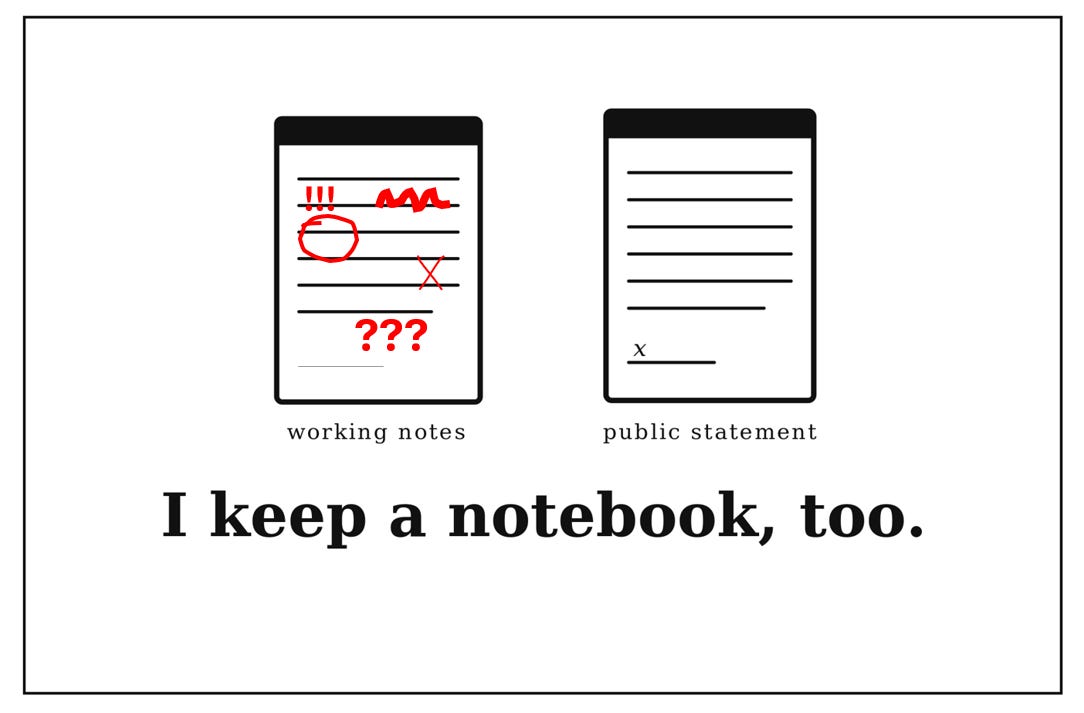
The mistake is failing to realize that a scientist’s private notes and a scientist’s public statements are two different kinds of writing with very different purposes. A notebook is where the uncertainty is meant to thrive: the third hypothesis you can’t rule out, the result that doesn’t fit with everything else, the important finding that you can’t seem to replicate, and the thing you suspect at 2am but abandon by Tuesday. If these thoughts are not in a notebook, they are hopefully showing up in conversation with a colleague over coffee - - stepping outside the bounds of what is “clearly supported by the data” to posit on what might be true.
The public statement is where you have to commit to a best current estimate. But a scientist whose private notes matched their press briefings, word for word, would be a scientist who had stopped thinking somewhere along the way.
I run into this in my own work all the time. What an internal draft of one of my own grants or manuscripts says about a mechanism, hedged and arguing with itself, is not what lands in the polished final submission.
If you have never worked in a lab, you might be surprised how many routine assays come with their own unexplained quirks that everyone in the lab learns to respect. (”I don’t know why, but this one always behaves better on a cloudy day when it hasn’t rained…”) We write those down in the notebook precisely because we cannot yet defend them in public.
The private notes and the public documents rely on the same data doing two different jobs, and taking time to hold on to the uncertainty and challenge it and work through its implications in the private portion of its lifecycle is a critical part of the process of scientific thought.
If you forget that, it is easy to condemn hedging in private as proof of lying in public. I find that to be an error of category: private uncertainty is what public confidence is eventually built on. So, too, would it be an error to read the contents of private journals as vindication of being correct. Both would be making the mistake of treating a private sketchpad for reasoning as a source of truth about the world, when it is really nothing more than evidence about what one person was thinking on one particular day.
If you had recorded every discussion I’ve had in private with colleagues over the years, working through theories and analyses of scientific data, you could very well categorize me as being often wrong.
Or, perhaps nearly always wrong.
But, eventually, through good faith debate and critical examination of data, I update my beliefs over time.
We have ended up in the unfortunate circumstance where public accountability now runs through document dumps of private materials curated by someone’s political opponent, and yet we have agreed on no method for reading them.
As far as I can tell, nobody has measured a basic question, which is whether releasing someone’s private communications tends to productively change anyone’s minds or just harden the ones already made. We should probably know that before we do it again next month to someone else.
So, before someone dumps my (or anyone else’s) private notes for the world to judge, a few questions to ask before forming a hard opinion:
Who chose the excerpts that would be released and highlighted, and what might they have left out?
Was this a working document meant to process internal thoughts and uncertainty, or a communication meant for other people?
What is the context in the pages that you never saw?
Am I at risk of forming a strong opinion based on second hand reporting, or have I read the primary notes myself?
Would I accept this standard if it were my notebook or my private conversations being judged, selectively dumped by someone who disliked me?
None of this is a claim that “both sides” here are equally right, or equally decent, or acting in equally good faith. I have my own opinions on that. I think that Paul & Co.’s belligerent pursuit of Fauci is unproductive and harmful for multiple reasons, but that’s beside the point of this letter.
Hopefully it is clear that I am making a narrower point about method and category: there is value to working through the uncertainty that is inherent to private notes and private conversations.
Acknowledging the different function of an uncertain private conversation or document vs. a best-current-guess public statement is what I would want applied to my own decision making, and what I would want applied equally to people I admire and people I cannot stand.
I have been wrong in private more times than I can count, and I will be again by Monday morning.
-Morgan
Morgan McSweeney, PhD
This is very well-written and immensely helpful. Your perspective is the correct one, of course and outlines the difference between private musings and public-facing position statements. We confuse the two at our peril. Private musings do NOT constitute 'lies' if not shared publicly. Shame on every single one of the senators who are not pushing back against this persecution-in-the-name-of-distraction.
I think the public's misunderstanding of uncertainty in science is the crux of their whole distrust of science in general. The classic example is the "it's just a theory" dismissal of scientific consensus, based on the difference between the scientific and layperson definitions of "theory". Scientists view uncertainty as a fact of life, and corrections as the active process of scientific progress. The public views uncertainty as ignorance, and corrections as evidence of mistakes or falsehoods. Releasing private notes to an audience primed to misunderstand them really wasn't intended to change minds or clarify things; it was just low blow to score political points. The challenge is that if Fauci's public statements had fully reflected his uncertainty, the public would have concluded that nobody knows anything and ignored the advice. Presenting clearer advice based on the best available information was more effective at the time, but left Fauci open to this nonsense. It's not clear what the "right" approach is for a scientist tasked with communicating uncertain science to the scientifically illiterate (and hostile). Pity Congress isn't tackling that problem, either.