‘Supported by Studies’ Doesn’t Mean What You Think It Means
A simple way to spot misleading claims without looking anything up.

There’s a reason so much modern health advice comes packaged with the same little badge of legitimacy.
“Supported by studies.”
Studies sound responsible. They sound scientific. They sound like the speaker is doing evidence-based medicine rather than internet-based vibes.
And of course, the obvious critique is true: not all studies are created equal. A mouse study, a tiny pilot trial, a correlation in a big cohort, and a well-powered randomized controlled trial can all be called “a study,” even though they deserve different levels of confidence.
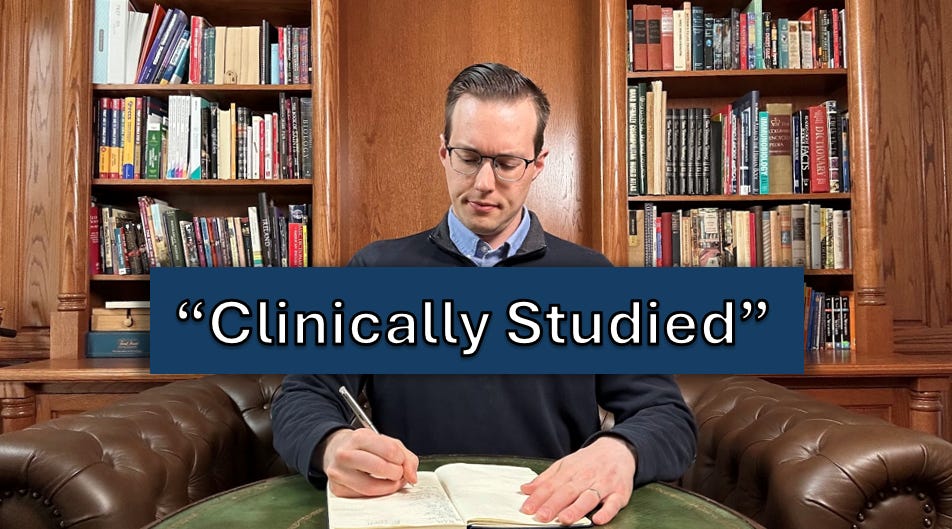
If you’re reading this, you already know that. Even if you’ve never put words to the intuition, you recognize that a supplement label that says “clinically studied” without providing further detail may have included 12 college students and a survey.
The more interesting problem occurs even when the methods and study design are high quality and no one is being misleading
Here’s the important part: you don’t need to look up the study to spot the problem we are discussing today.
Most of the time, the giveaway is already in the claim.
This letter is about learning to hear when a claim has grown larger and broader than the evidence. Larger than any reasonable study could generate.
Once you notice that mismatch, you’ll start hearing it everywhere.
Why “supported by studies” works so well
From a marketing perspective, “supported by studies” is brilliant.
It implies that the argument has already been settled somewhere else, by people in lab coats, and that you’re now allowed to skip to: why don’t I give it a try?
It also politely suggests that asking for details would be inelegant, the equivalent of requesting the raw footage after someone says a movie “won an award.”
You will never be able to chase down the citations for every health claim that passes through your feed. So, the phrase signals a mental shortcut: studies exist, therefore the claim is grounded.
Here’s the thing - science is a constraint system. It narrows what you can say, under what conditions, in who, and with what confidence.
“Supported by studies” is frequently used to do the opposite. It widens what a study can be made to imply. That’s convenient if you’re looking to sell a product or an idea, but deeply misleading if you’re looking to act in the best interest of your health.
Translation Creep: where the slippage happens
The pattern I see most often is translation creep.
By that, I mean that a study measured one thing, in one population, over one timeframe.
Then, outside the paper, that result gets extrapolated into a larger promise.
A change in some specific biomarker broadens into “improves health.”
A benefit observed in a specific population becomes “everyone should do this.”
A mechanistic finding becomes “prevents disease.”
Research studies ask narrow questions and get narrow answers. Marketing claims invent much bigger questions and borrow those narrow answers.
A high-quality research study measures one tree very carefully. Marketing then uses that measurement to make claims about the entire forest.
This is why “study quality” is sometimes a distraction
There’s an irony I want to drive home: even high-quality evidence can be misused if it’s being cited to support a different claim than the one it actually tested.
A well-designed randomized trial can be turned into a weak claim if the result is generalized beyond the population studied, beyond the timeframe studied, or beyond the outcome studied.
This is why you can have two people on the internet cite “studies” to support opposite conclusions. They’re not necessarily fighting over whether the cited studies exist. They’re fighting over how far the studies can be stretched.
In the paid section of this letter, I lay out the simplest framework I know for catching this kind of claim drift in real time (without having to pull up the research article…) and for explaining it to other people in one or two sentences.
This is something you can use for yourself while scrolling or mid-conversation, and without any notes or prep.
Last, I present a few practice claims for you to train on (some suspiciously broad, some appropriately narrow).
A few recent comments from paid subscribers, shown as they appear on Substack: