

Supplements: Making sense of USP, NSF, and GMP

Bottom line up front: These acronyms are useful quality tools. However, they can not provide proof that a supplement works. They help answer different narrow questions about manufacturing and verification like “Was this made properly?” and “Does the dose match the label?”
Here’s where this matters in the real world: when CVS decided to require third-party testing for every supplement it sells, they found that about 7% of products failed and had to be reformulated or removed from the shelves.
When studies check the quality of dietary supplements, there can be huge differences across products, and some don’t meet even the most basic quality and labeling expectations.
That’s the gap these labels like “USP” and “NSF” are trying to fill.
The three questions that get blurred together
Most people implicitly roll several very different questions into one:
Was this specific product made in a controlled, documented way?
Does each dose contain what the label says it contains, without specific contaminants?
Does this product actually improve health outcomes? Do its benefits outweigh its risks?
Different labels answer different parts of that list.
GMP mostly addresses question #1
USP and NSF mostly address question #2
None of them address question #3
Keeping those questions separate clears up most of the confusion.
GMP: how it was made
GMP stands for Good Manufacturing Practices. In the U.S., GMP compliance for dietary supplements is legally required. That means that saying “GMP” on a label usually tells you very little about how well that requirement is actually being met.
GMP means the manufacturer follows FDA rules that govern things like sanitation, documentation, ingredient handling, and quality control systems. It reduces the chance of sloppy mistakes, mix-ups, or contamination.
What GMP does not do is certify that:
the finished product matches the label
the dose is biologically or clinically meaningful
the supplement is safe to consume
At its core, GMP tells you about the factory’s habits.
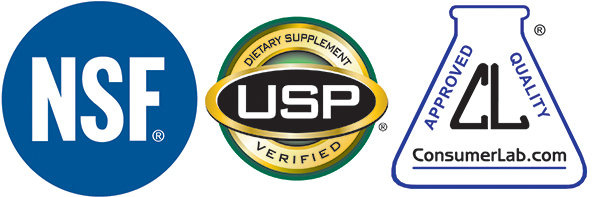
Independent quality verification (USP, NSF, and others)
Once GMP is assumed (due to the legal requirement), the real question becomes:
What extra reassurance do I want beyond basic manufacturing rules?
This is where USP and NSF come in.
For most people, it’s more helpful to think of USP and NSF together rather than as competing systems. Both are attempts to independently check whether a product matches its label and meets defined quality criteria.
At a high level, they aim to reduce uncertainty about:
whether the ingredient is actually present at the stated amount
whether certain known contaminants are below defined limits
That’s meaningful information, especially in a market where many products are never independently verified at all.
Where they differ…
You don’t really need to memorize this, but it helps to know the emphasis of USP vs. NSF:
USP focuses on whether a product meets predefined standards for identity, purity, strength, and performance
NSF focuses on independent testing against program-specific criteria, often with stronger emphasis on contamination screening.
In practice:
USP is often most informative for simple, single-ingredient supplements (like vitamins and minerals)
NSF is often most informative for complex products (like protein powders or multi-ingredient blends)
For most everyday use, either mark generally serves the same practical purpose: confirming that someone outside the manufacturer checked the product in some way.
If someone chooses to buy a supplement, third-party verification is one of the few signals that actually reduces uncertainty around the quality of a product.
What independent verification still does not do
Even when a supplement carries a USP or NSF mark, that verification does not:
assess clinical benefit or risk
determine whether the supplement is worth taking for you (or anyone)
tell you whether the dose meaningfully improves health outcomes
Quality verification narrows uncertainty about what’s in that specific bottle.
The takeaway
If you remember nothing else, remember this:
GMP is legally required and describes how a supplement was made
USP / NSF indicate third-party checks that the label is likely honest and certain quality standards were met
None of these labels tell you whether a specific supplement is a good idea for your health.
Excellent breakdown of a genuinely confusing space. The distinction between manufacturing quality and actual clinical efficacy gets lost all the time. I remember buying magnesium last year and feeling kinda silly realizing the USP label just meant the dose was accurate, not that magnesium itself was necessarily gonna fix my sleep. The CVS stat about 7% failure is wild though, makes you wonder how many non-tested supplements are just complete garbage.
Really appreciate this breakdown, Dr. Noc! It cleanly separates the three questions patients (and honestly, plenty of clinicians) tend to mash together: manufacturing process (GMP), label accuracy/contaminants (USP/NSF), and clinical benefit (evidence). 
From a clinician-scientist perspective, that distinction is the whole game: USP/NSF can meaningfully reduce uncertainty about what’s in the bottle, but they don’t answer whether the ingredient improves outcomes for a given person, at a given dose, with acceptable risk. 
Also striking (and very practical) is the real-world signal you cited: when CVS required third-party testing, ~7% of supplements failed and were reformulated or removed, a reminder that “buyer beware” isn’t paranoia; it’s a rational response to variable quality. 
If someone is choosing to supplement, your framework is a great quick filter: (1) verify quality (USP/NSF), (2) verify dose/interaction risk, (3) verify evidence for the actual goal and be willing to stop if #3 isn’t there.